How to Choose an AI Model for Your Website (No PhD Needed)
How to choose an AI model for your website chatbot: what actually matters, why models retire, and why the freedom to switch beats the perfect pick.
From the AnswerRails development blog — plain-English notes on the technology behind trustworthy AI chat.
Every AI assistant’s setup has a dropdown full of model names that read like licence plates. Here’s how to choose one without a research degree. The short version: the choice matters less than you fear, and the parts that matter aren’t on any leaderboard.
The leaderboard trap
Benchmark charts rank models at graduate maths and bar exams. Your assistant’s job is answering questions about your opening hours and prices from a knowledge base you wrote. Nearly every mainstream model can do that, including the economical ones.
The differences that matter are boring: does it do as it’s told, what does it cost, will it exist next year, and what happens on a bad day. Boring questions have checkable answers.
Does it do as it’s told?
The most valuable trait in a model is obedience, not brilliance. Early in this project, a small model invented two products that never existed rather than admit a gap. A middling model that reliably follows “answer only from the knowledge base, and say so when you can’t” is worth more on your website than a brilliant one that freelances.
What does a conversation cost?
With a bring-your-own-key product, the meter is yours: usage runs on your own provider account at published rates. Between a flagship model and an economical one, those rates can differ by a factor of ten. Because a grounded assistant’s answers come from your knowledge base, flagship rates buy less than you’d think. Start at the economical end; move up later with your own bill in front of you.
Models retire — and nobody sends you a letter
Providers switch old models off. If nobody was watching the calendar, retirement day is the day your chat window stops working.
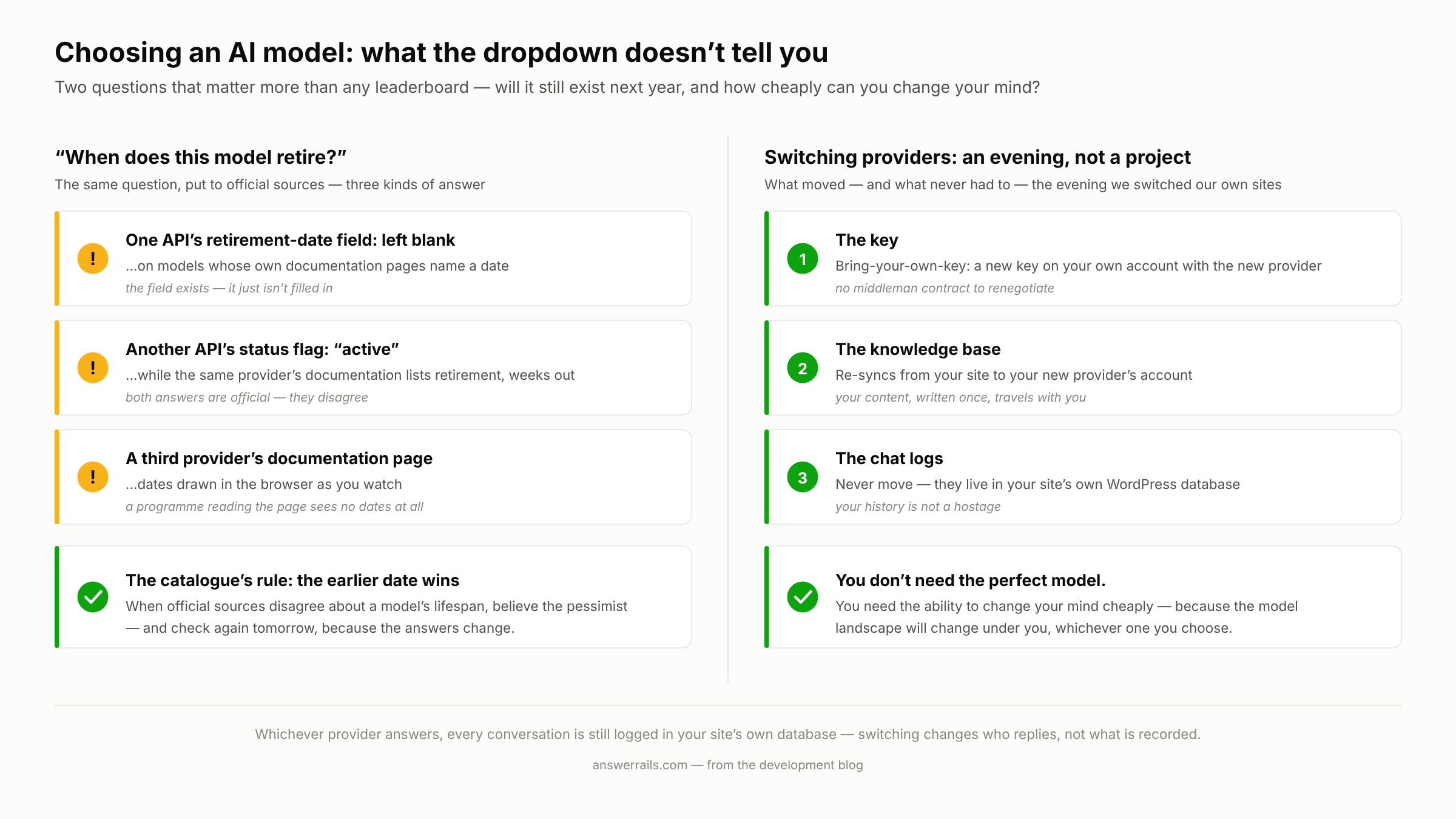
We maintain the model catalogue behind AnswerRails’s picker. Refreshing it against providers’ official sources, the question “when does this model retire?” got three kinds of answer: an API date field left blank while the documentation named one; an API saying a model was active while the documentation listed its retirement weeks out; and dates published on a page a programme can’t read.
So the catalogue follows a pessimist’s rule: when two official sources disagree, believe the earlier date. In AnswerRails that surfaces as a plain advisory beside your chosen model, ahead of the date, with somewhere to move to.
The evening we changed providers before dinner
One September evening, the provider behind two of our own sites refused every chat request for more than ninety minutes. We were on free, best-effort capacity — fine for evaluating an assistant, not something to lean a business on.
We moved both sites to a different provider the same evening, before dinner. A new key on our own account with the new provider, the knowledge base re-synced at the press of a button, and the chat logs never moved — they live in the site’s own WordPress database.
Your knowledge base and your chat history are your phone number: because they move with you, the choice of network stops being agonising. The real question about any model isn’t “is this the best one?” but “if I change my mind, what moves with me?”
Three questions for any vendor
If my model is scheduled for retirement, how will I find out — from your software in advance, or from a dead chat window? What does switching models or providers involve, and which of my things move with me? And whose account does the usage run on — can I see the meter myself?
Start economical, prefer obedient, check the retirement calendar, and weigh the exit before the entrance. That’s the whole method. No PhD required.
AnswerRails is a WordPress plugin bringing safe, grounded AI chat to small-business websites. More at answerrails.com.