Bring Your Own Key: Whose Bill Is Your Website’s AI On?
What 'bring your own key' (BYOK) means for a website AI assistant: your own provider account, provider prices, and no middleman in the data path.
From the AnswerRails development blog — plain-English explanations of the technology behind trustworthy AI chat.
If you have been comparing AI chatbot plugins for your website, you will sooner or later meet the phrase bring your own key — sometimes shortened to BYOK. It sounds like a piece of insider jargon, and it is usually explained badly or not at all. But of all the checkboxes on a chatbot comparison table, this one may tell you the most about who you would really be doing business with. So this week: what “bring your own key” actually means, why we built AnswerRails that way on purpose, and the honest downsides nobody puts on the pricing page.
The short version: BYOK means the meter is yours.
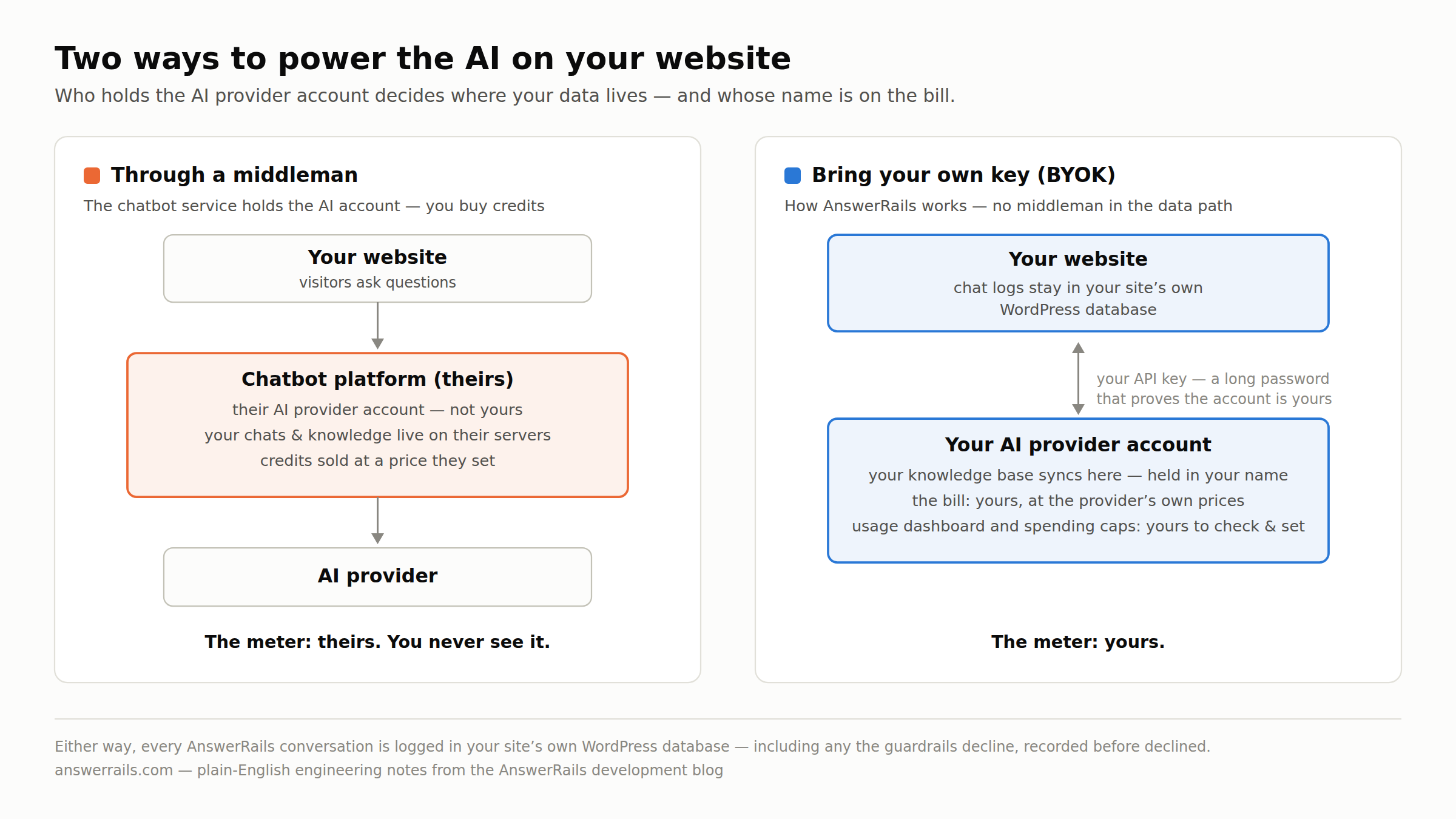
The bill with someone else’s name on it
Think about renting a flat where the electricity is “included”. It is convenient — one payment, no accounts to set up. But you never see the meter. You do not know what the landlord pays for a unit or what you are being charged for one. You cannot shop around for a better tariff. And if the landlord disappears, so does your power, because the account was never yours.
A great many AI chatbot services work exactly like that flat. Behind the scenes, almost every chatbot is powered by one of a handful of big AI providers. The service you sign up with holds its account with a provider, buys AI capacity at one price, and sells it on to you as “credits” or “message packs” at another. Your conversations flow through their platform, your knowledge lives on their servers, and your relationship with the actual AI provider is entirely second-hand.
Bring your own key is the other arrangement: the account with the AI provider is yours. The “key” is nothing mysterious — an API key is just a long password that proves a request is coming from your account. You create an account with an AI provider, generate a key, and paste it into the plugin. From then on, your website’s assistant talks directly to the provider you hold the account with, and every penny of AI usage appears on your own bill, at the provider’s own published prices.
Why we chose the direct arrangement
When we designed AnswerRails, we made this a foundation, not an option. There is no middleman in the data path: your chat logs live in your site’s own WordPress database, your knowledge base syncs to your own AI provider account, and no third-party platform of ours sits between your website and your provider. The relationship — and the bill — is directly between you and them.
Three things follow from that, and each one matters more for a small business than the brochures suggest.
The markup disappears. When AI usage is resold as credits, the reseller’s margin is baked into a price you cannot inspect. With your own key you pay what the provider charges, and for a small business site’s chat traffic that is usually a modest number — the kind you glance at, not the kind you budget meetings about. More importantly, it is a visible number.
The meter is readable. Your provider’s own dashboard shows exactly what your assistant is spending, and providers let you set spending caps on your own account. When a chatbot service sells you credits instead, “how much AI am I actually using?” is a question only they can answer — and they set the exchange rate.
Your assistant survives us. This is the one we think about most. If our company vanished tomorrow, what would you actually lose? Not your data: the conversations are in your WordPress database, on your hosting. Not your knowledge: it is synced to your own provider account, which you hold in your own name. The working materials of your assistant live where you can reach them — a claim no credits-reselling platform can honestly make, because with a middleman, the middleman is where everything lives.
The honest downsides
We would be doing exactly what we criticise in vendors if we pretended this arrangement were free of trade-offs. It is not.
There is a real setup step. Creating a provider account and generating a key takes a few minutes and feels unfamiliar the first time. Bundled credits are simpler to start with — that is their entire appeal, and it is a fair one. Our answer is to make the key screen as plain as we can (it is the least glamorous screen in the plugin, and the one we have reworked the most), but we will not pretend the step is invisible.
The usage is yours — including the usage you did not intend. Because strangers chat with your assistant on your provider account, a visitor who tries to abuse the assistant is, in a small way, spending your money. This is precisely why we treat guardrails as a first-class feature rather than a bolt-on: we wrote about what those checks actually do, and a good part of the answer is protecting the owner’s account from misuse, not just protecting visitors from bad answers.
Providers change things. Models get retired, prices move. That is true behind a middleman too — you just do not see it happening. The plugin’s job is to make the direct relationship manageable: it ships a catalogue of models described in plain English, and it tells you when a provider has scheduled one you are using for retirement, rather than leaving you to read developer changelogs.
Starting without a bill at all
“Your own account” does not have to mean “your own spending”. Most providers offer free tiers, and a free-tier key is still your key — the arrangement is the same, the meter simply reads zero. And for the searching half of the assistant’s work, AnswerRails includes a local keyword mode that runs in your site’s own database and needs no provider account for the search at all. The direct arrangement scales down as honestly as it scales up — readers of our first post will remember that the whole system is designed to keep working, and to say so plainly, even when a provider is having a bad day.
Three questions to ask any vendor
- Who holds the AI provider account — you or me — and whose name is on the bill? “Yours, at the provider’s own prices” is the direct arrangement. “Ours — you buy credits from us” means there is a meter you will never see.
- If your company disappeared tomorrow, where would my assistant’s knowledge and chat history physically be? The comfortable answer names places you control. The uncomfortable answer is a shrug.
- Can I see my assistant’s AI usage on the provider’s own dashboard and cap it there myself? If the answer is no, your spending limit is a matter of trust rather than a setting.
None of this makes bundled credits wicked — for some owners, simplest rightly wins. But you should know which arrangement you are signing, because one of them leaves the meter, the data, and the relationship in your name. Next week: where your visitors’ chat data goes — who can see a conversation with your assistant, and what an honest answer to that question looks like.
AnswerRails is a WordPress plugin that adds a compliance-first, public-facing AI assistant to your website — with guardrails, citations, and honest reporting built in. Learn more at answerrails.com.